

Blog
The Resilient PMO: Why Infrastructure Projects Fail Without Honest Data

Prefer to watch on social media? Click here to watch this video on YouTube.
FR Francophone ? Cliquez ici pour regarder cette masterclass en français.
Are your complex infrastructure projects flying blind? To survive the realities of modern construction, you need a Resilient PMO.
In Episode 1 of our Masterclass Series, we explored why Scope and Risk are the true drivers of accurate civil engineering cost estimating. But what happens once that budget is approved and construction begins? Even the most rigorous estimate will fail if it is not supported by a schedule built to withstand reality.
When most executives hear the acronym PMO (Project Management Office), they picture administrative overhead. They imagine “traffic cops” who schedule meetings, chase down timesheets, and color-code Gantt charts to ensure a project looks green on a dashboard.
But in complex civil engineering and infrastructure development, an administrative PMO is not just inefficient—it is dangerous.
When a PMO focuses solely on paperwork rather than the engineering reality on the ground, executives end up flying blind. By the time a project’s status changes from “Green” to “Red,” millions of dollars and months of schedule float have already been lost.
You don’t need more administrators. To survive the complexities of modern construction, you need a Resilient PMO—an engine driven by data, built to absorb shocks, and designed to tell the truth.
The Trap of the “Traffic Cop” PMO
A traditional PMO focuses solely on compliance, reporting, and rearview mirror tracking.
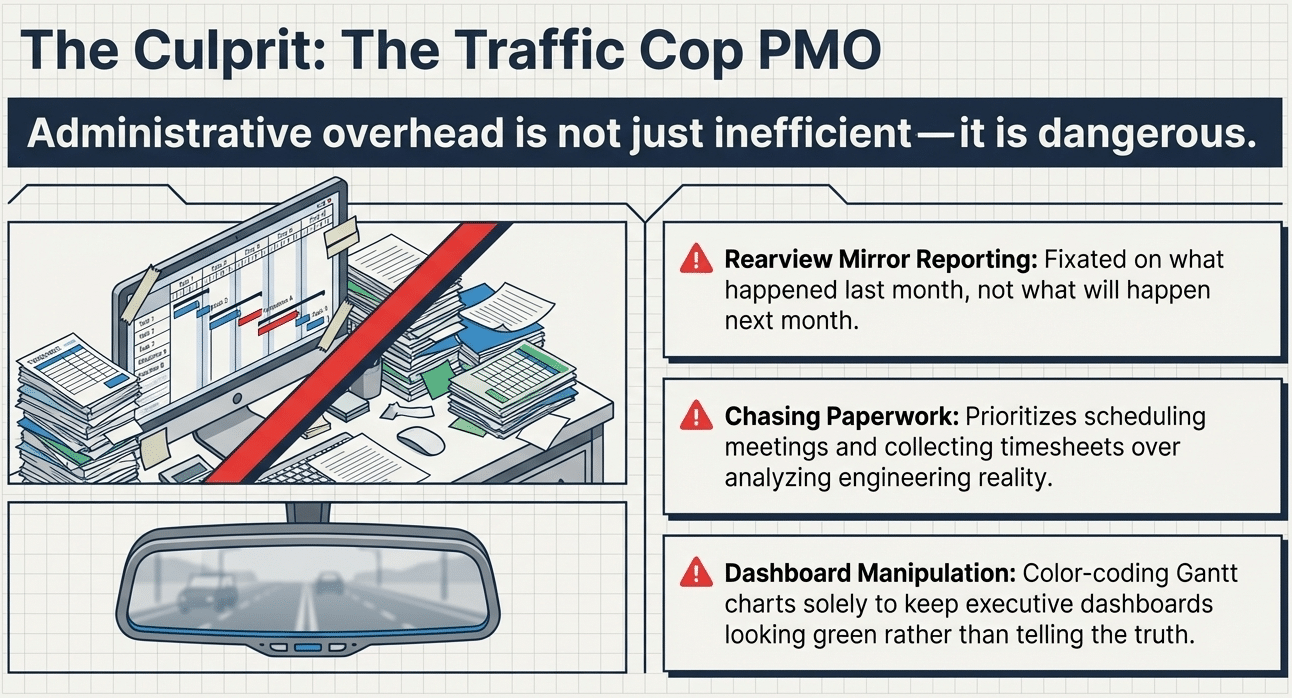
This model operates strictly by looking in the rearview mirror, reporting on last month’s data rather than predicting tomorrow’s risks. They ask, “Did we spend the budget we planned to spend?”
The problem with this approach is that it disconnects the budget from actual physical progress. If a contractor spent 50% of the budget but only poured 20% of the concrete, an administrative PMO might just see that the spending is “on track.” An engineering-led, Resilient PMO sees a critical failure in the making.
This is the difference between project administration and project controls. Project controls is the science of variance analysis—spotting the anomaly before it hits the bottom line. The lack of these controls has dire consequences: according to the Project Management Institute (PMI), organizations waste over 11% of their investment dollars due to poor project performance. Furthermore, the American Society of Civil Engineers (ASCE) routinely emphasizes that with a multi-trillion-dollar infrastructure backlog, delays and cost overruns are systemic issues that simple administrative tracking cannot fix.
Resilient PMO vs. Traditional PMO Concepts
| Model Type | Primary Focus | Tracking Methodology | Result / Strategic Outcome |
|---|---|---|---|
| Traditional “Traffic Cop” PMO | Administrative Compliance, Paperwork, and Reporting. | Rearview Mirror: Budget Spend vs. Plan. Disconnected from physical work. | “Flying Blind”: Problems recognized months after they occur, leading to waste and massive overruns. |
| Resilient “Engineering” PMO | Strategic Value Delivery and Engineering Reality on the Ground. | Advanced Analysis: Integrated Scope, Schedule, & Cost. Mathematical Modeling of Risk. | Radical Transparency: Spotting anomalies early, optimizing fund utilization, and ensuring efficient fund usage. |
The “Ph.D. Approach”: What is a Resilient PMO?
“The future of the PMO is not about administrative control; it is about strategic value delivery and driving business results.”
As thought leaders advocate, a modern PMO must evolve beyond reporting. My Ph.D. research refined this concept, focusing on Schedule Resilience, which acts as the foundational theory behind the Resilient PMO.
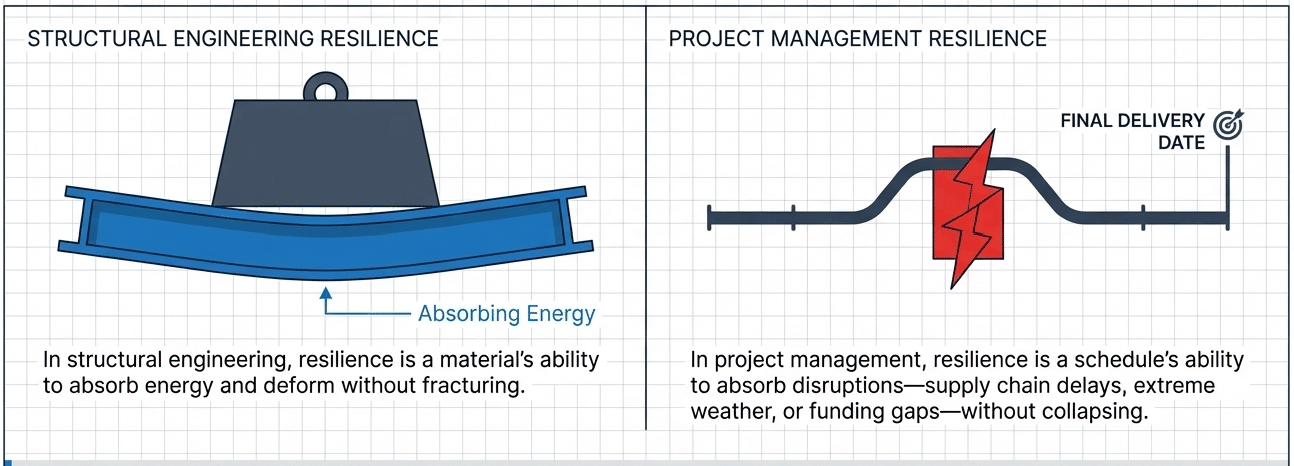
In structural engineering, resilience is a material’s ability to absorb energy and deform without fracturing. In project management, resilience is a schedule’s ability to absorb disruptions—supply chain delays, extreme weather, or funding gaps—without collapsing.
A Resilient PMO operates on three core pillars:
Pillar 1: The Critical Path is King (Math Over Politics)
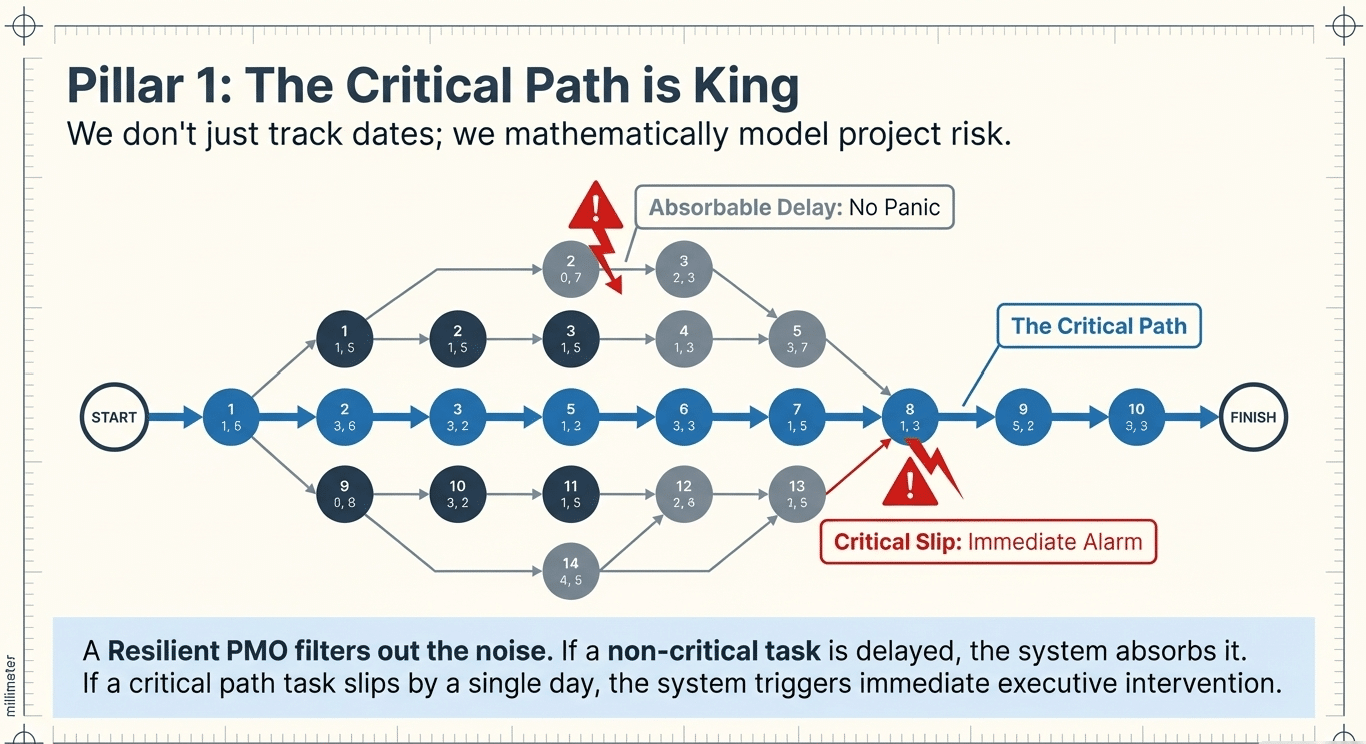
Infrastructure projects are complex, with thousands of interdependencies. A resilient PMO does not build schedules on “intuition” or hope; it builds them on modeling and math.
By identifying the critical path (the sequence of steps that must be completed on time to prevent delay), the PMO can run What-If analyses and Monte Carlo simulations. This approach quantifies risk into hard data, rather than anecdotal “reporting” that obscures the project’s true health.
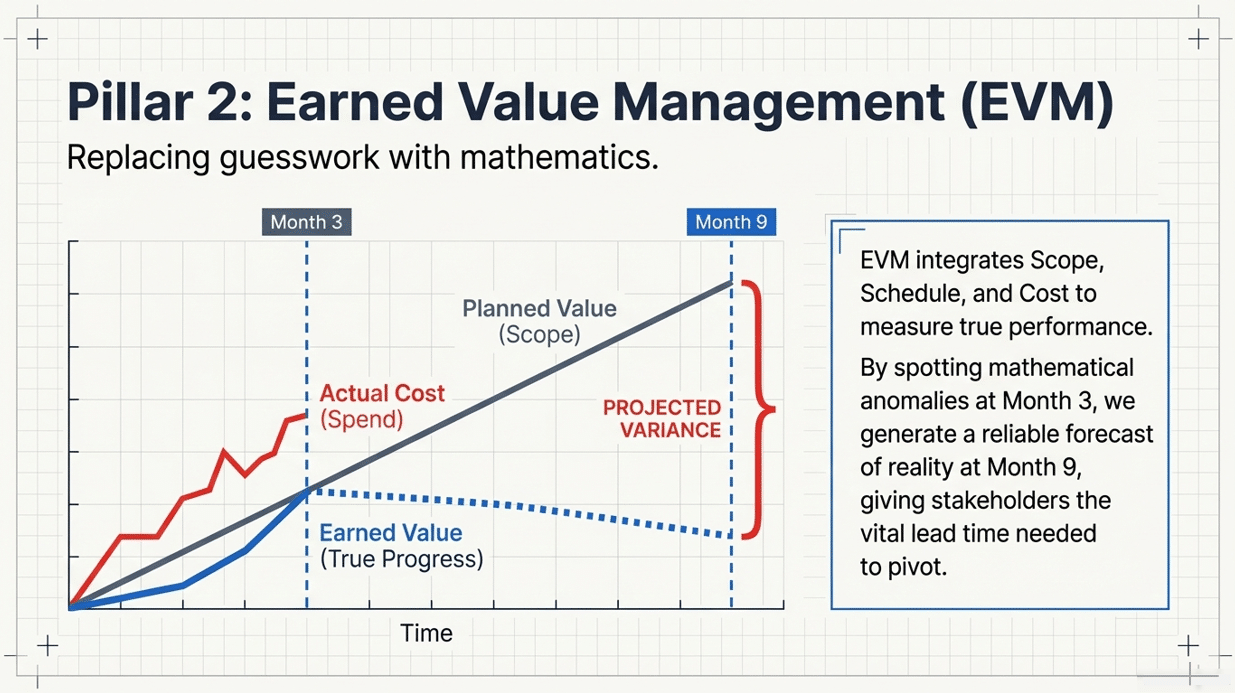
Pillar 2: Earned Value Management (EVM) for Proactive Forecasts
Traditional PMOs are retrospective, reporting historical cost and schedule performance data. This method is useless for prevention. By the time a dashboard turns red, the project is already off the rails.
A resilient PMO adopts Earned Value Management (EVM). EVM integrates cost, schedule, and scope into a single set of metrics that provide a proactive, mathematical forecast of a project’s future. It provides the institution with reliable, unbiased “canaries in the coal mine” that alert executives to systemic delays 6 months before they hit the field.
Pillar 3: Radical Transparency and Courage Institutional
The previous two pillars provide the “how.” This pillar provides the “why.” Data and math are powerless if the organizational culture is built on “tableaux de bord verts” (green dashboards) that hide the truth.
True resilience requires radical transparency—a commitment to unvarnished, data-driven reporting that filters out noise. It demands that executives and project managers develop the courage institutionnel to embrace painful, uncomfortable data, rather than manipulating it to secure the next tranche of funding.

The “Federal Insider” Standard for a Resilient PMO
In my experience managing complex infrastructure portfolios for the U.S. Army Corps of Engineers (USACE) and the Department of Veterans Affairs (VA), resilience isn’t optional; it is mandated. Federal agencies require stringent, audit-ready data from Day 1.
By utilizing an advanced analytical engine that merges engineering knowledge with data science tools, we deliver Federal-level rigor to global projects. Whether you are a Prime Contractor requiring bulletproof documentation for audits or an International Development Partner securing funds in Africa, a Resilient PMO provides crucial transparency and protects your investment.
Conclusion: Build a Resilient PMO to Move From Chaos to Control
A project schedule is not just a calendar; it is a mathematical model of your project’s risk. If your current PMO is only telling you what happened yesterday, you are leaving your project’s future to chance.
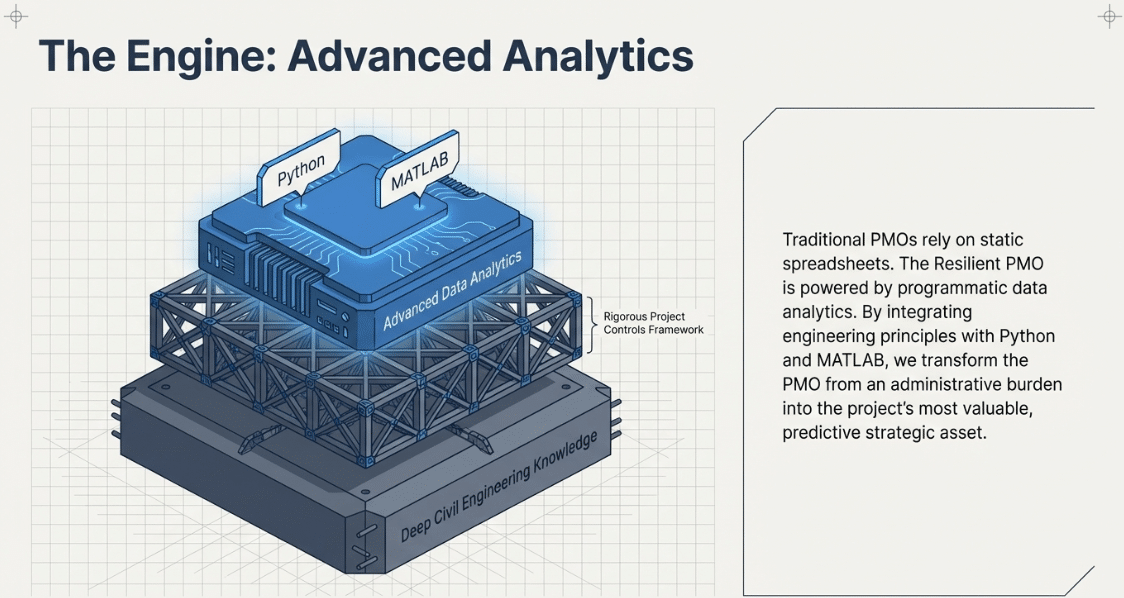
We transform the PMO from an administrative burden into the most valuable strategic asset your project has. Is your infrastructure project flying blind, or are you ready to build a Resilient PMO?
Explore AI&GB Consulting’s Project Controls and PMO Services today, and let us provide the flight plan for your next infrastructure initiative.
🧠 Expert Insights Q&A
For those navigating the complexities of large-scale infrastructure, here are the most common questions we receive regarding the transition to a Resilient PMO and the application of advanced project controls:
Q1: What is the primary problem with the traditional PMO’s approach to monitoring spending?
A: It disconnects the budget from actual physical progress. An administrative PMO might see that spending is “on track” without realizing the physical work is severely lagging.
Q2: What is the main consequence of managing projects without “honest data”?
A: Projects “fly blind,” leading to inevitable failure and wasted investment. Radical transparency is required to force hard decisions early.
Q3: What is the significance of the Critical Path in a Resilient PMO?
A: It is used to mathematically model the project’s risk. If a non-critical task is delayed, a resilient system absorbs the shock. If a critical path task slips, alarm bells ring immediately.
Q4: Which project management methodology integrates scope, schedule, and cost to measure true performance?
A: Earned Value Management (EVM).
Q5: How does EVM replace “guesswork” in project management?
A: By using mathematics to integrate and measure scope, schedule, and cost. This allows project leaders to generate reliable forecasts of where the project will be months in advance, giving stakeholders the vital lead time needed to pivot.
Dr. Armelle Malcomb is the Founder of AI&GB Consulting LLC. With a Ph.D. in Civil Engineering and over 20 years of experience, she specializes in bringing federal-level Project Controls, Cost Engineering, and Data Analysis to global infrastructure challenges.