

Blog
Why Civil Engineering Cost Estimating Fails: It’s Not the Math, It’s the Scope

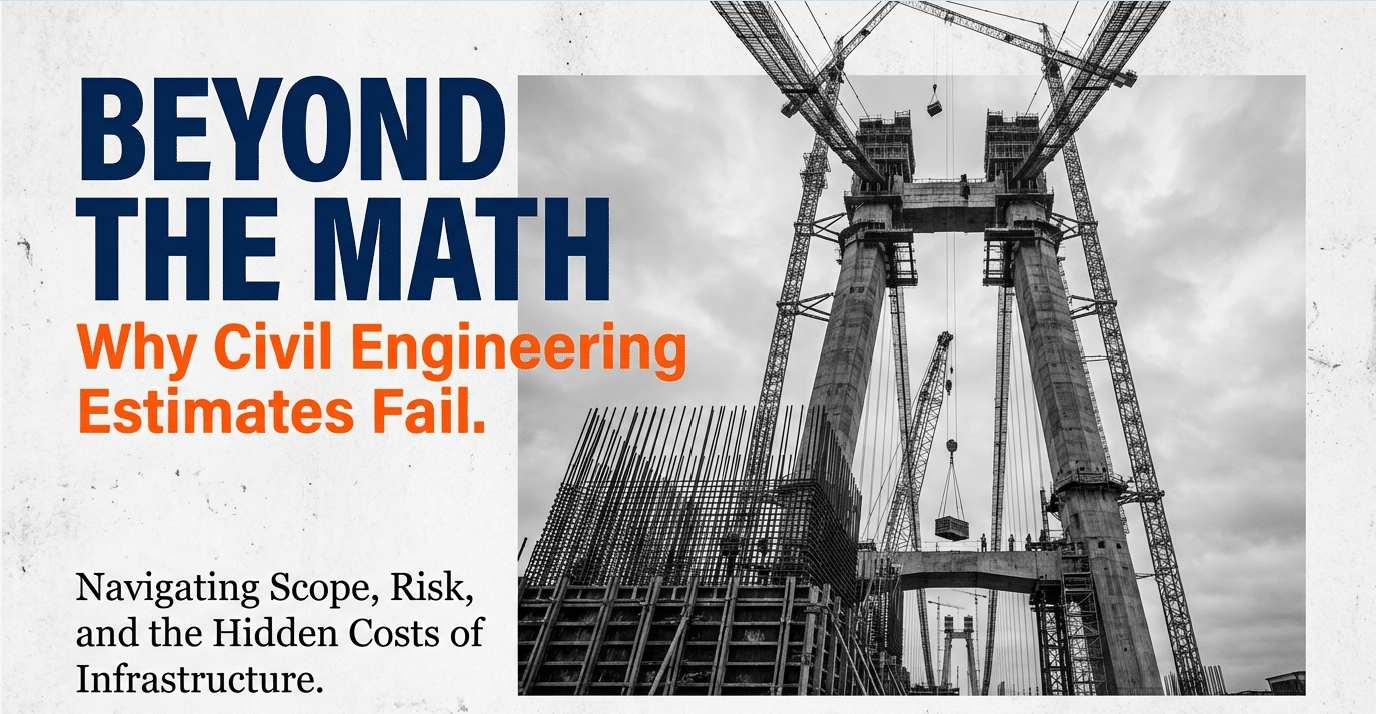
Prefer to watch on social media? Click here to watch this video on YouTube.
In my twenty years of Civil Engineering Cost Estimating as a Senior Cost Engineer, managing complex infrastructure while adhering to various federal, state, and international standards—such as those of the American Society of Civil Engineers (ASCE)—I have reviewed hundreds of project budgets. From hospital renovations in Maryland to transportation projects in West Africa, the financial patterns remain strikingly similar.
There is one question I have never heard a Project Manager ask at the end of a job:
“We have all this money left over… what should we do with it?”
In 99% of projects, the question is the exact opposite: “Why did the costs increase so much?”
The answer is rarely about the math. Most engineers can calculate the volume of concrete or the tonnage of steel with extreme precision. The failure usually happens before the first calculation is even made. It happens in the definition of Scope and the management of Risk.
Civil engineering cost estimating is not just about pricing materials; it is about predicting the future in a chaotic environment. Here are the expert principles that separate a reliable estimate from a dangerous guess.
The Iceberg Principle: The “Invisible” Scope in Civil Engineering Cost Estimating
In infrastructure projects, we often encounter what I call the Iceberg Principle. Most stakeholders focus only on the “tip”— the visible costs of materials and labor. However, the true success or failure of civil engineering cost estimating is determined by the 90% of the project that lies beneath the surface: the “Invisible” Scope.
If you hand the same set of plans and specifications to three different estimators, you will likely receive three vastly different numbers.
This discrepancy occurs because truly effective civil engineering cost estimating requires looking far beyond the page and into the “Invisible Scope”—factors such as restricted site access, local labor market dynamics, and seasonal logistics that are rarely captured in a standard drawing.
Drawings tell you what to build. They rarely tell you the constraints of how it must be built. The “Invisible Scope” includes the external factors that don’t appear on the page but often drive the price tag higher than the materials themselves.
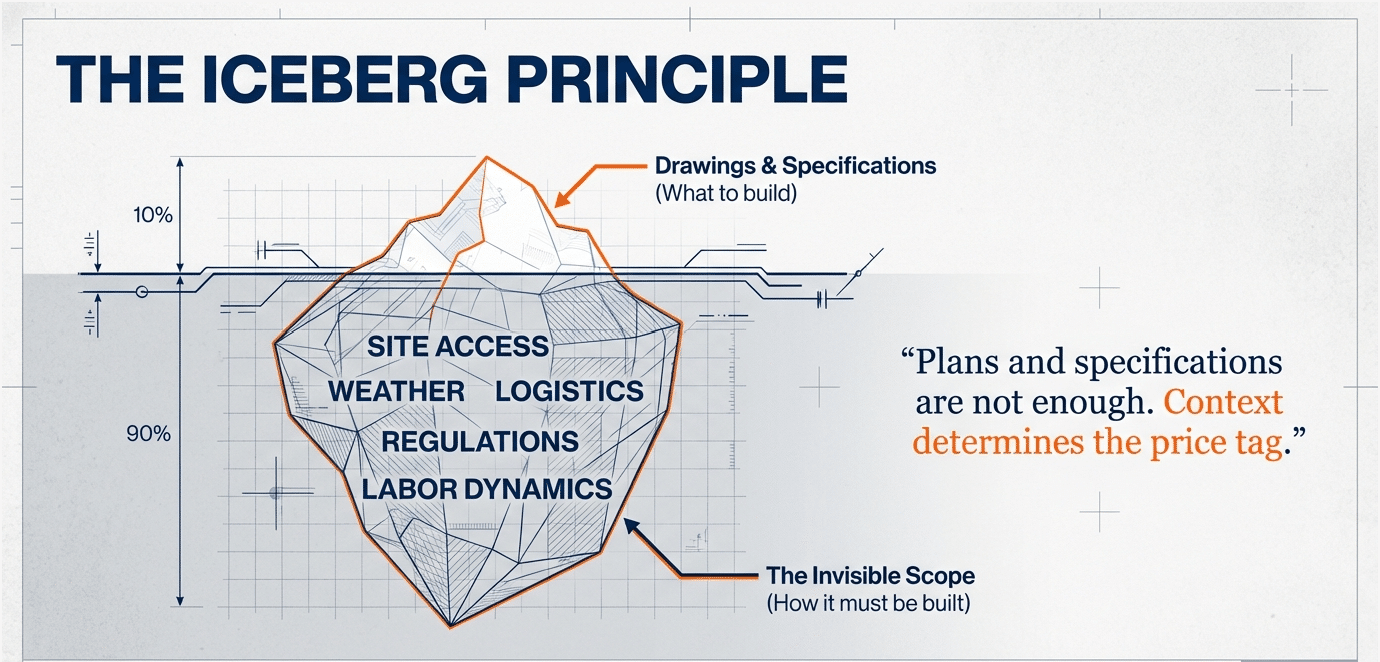
When developing a comprehensive civil engineering cost estimate, we must look beyond the drawings and ask the hard questions about the context:
| Logistics & Access: Can we access the site 24/7, or are we limited to a 4-hour window due to local traffic, school zones, or security protocols? A restricted schedule can double your labor duration. | |
| Environmental Constraints: Will the rainy season in this specific region delay earthworks by two months? Are there noise ordinances that prevent night work? | |
| Supply Chain Realities: Are critical materials, like specialized switchgear or structural steel, available locally? Or do they have a 12-month lead time that pushes the project into a new fiscal year? | |
| Labor Market Dynamics: Is the region facing a skilled labor shortage? If a nearby mega-project is absorbing the local workforce, you may face premium labor rates or significant delays. | |
| Economic Volatility: Are high inflation rates eroding the project’s purchasing power? Financial constraints mean that a budget set today may be insufficient six months from now without proper escalation clauses. | |
| Global Disruptions: Have pandemics (e.g., COVID-19) or other force majeure events altered standard operating procedures? New health protocols can reduce crew density, lowering productivity and extending the schedule. |
Expert Tip: Never assume standard conditions. Context is expensive. If your estimator isn’t asking about the site conditions, local labor availability, and seasonal constraints, the civil engineering cost estimating process is incomplete.
Contingency is for Risks, Not Mistakes
In the private sector, contingency is often dismissed as a “slush fund”—a flat 5% or 10% added at the end of a budget “just in case” something was overlooked. However, in high-stakes infrastructure, we treat contingency as a strategic Risk Management Tool.
We know something will go wrong; we simply don’t know what. Whether it is unforeseen soil conditions, a sudden spike in fuel prices, or a critical design change, uncertainty is inevitable. To ensure our civil engineering cost estimating remains resilient and rigorous, we adhere to global Cost Management Standards, such as those established by the Association for the Advancement of Cost Engineering (AACE) International.
A resilient civil engineering cost estimating strategy utilizes a Risk Register to identify these uncertainties and assign a specific dollar value to each. This shift moves contingency from a vague “guess” to a calculated, defensible buffer.
Treating contingency as a calculated buffer requires a structured approach. The industry follows specific benchmarks to determine the appropriate level of protection based on the nature of the work. For example, a sliding scale for contingency is typically applied based on the complexity and current phase of the project:
Typical Civil Engineering Cost Estimating Risk Guidelines
| Project Type / Phase | Recommended Contingency | Why? |
|---|---|---|
| New Construction | 5% | Conditions are easier to predict; fewer unknowns. |
| Renovation | 10% – 15% | High risk of hidden conditions behind walls or underground. |
| Early Concept Design | 20% – 30% | The scope is not yet fully defined. |
Expert Tip: Do not hide contingency in your unit prices. Keep it as a separate, visible line item. This allows the Project Manager to track how much “risk budget” is being consumed as the project progresses.
The Cost of Time: Escalation Factors & The Critical Path
One of the most common reasons for budget overruns is the failure to account for the symbiotic relationship between Schedule and Cost. A project estimated in 2025 dollars simply cannot be built in 2027 for the same price.
Escalation is the provision for cost increases over time, driven by inflation, market changes, and labor rate hikes. However, escalation does not happen in a vacuum—it is driven entirely by the project schedule.
This is why advanced project controls for civil engineering cost estimating rely on Cost-Loaded CPM Schedules. A delay on a Critical Path activity does more than just push the completion date; it directly increases overhead and exposes the remaining budget to future inflation.
In federal projects, we calculate escalation to the “midpoint of construction,” but we must also model the impact of potential delays. If permitting stalls the project by six months, the estimator must immediately adjust the escalation factor to reflect the loss of buying power.
Expert Tip: When reviewing a budget, always ask for the “basis of estimate.” If it doesn’t include a schedule-linked escalation calculation, your budget is a static snapshot of a moving target.
The Power of “Why”: The Value Engineering Process
Ultimately, the most powerful tool in civil engineering cost estimating is not a sophisticated piece of software—it is technical communication. While a spreadsheet can indicate that a retaining wall costs $50,000, it requires a strategic conversation to uncover why that wall exists in the first place.
Is it a structural, load-bearing component designed for future expansion, or is it merely an acoustic barrier? When a cost engineer understands the design intent, they can provide proactive Value Engineering solutions. For instance, transitioning from a cast-in-place wall to a precast concrete alternative, or modifying site grading to eliminate a wall entirely, can drive significant savings without compromising project quality.
The following diagram illustrates the Value Engineering Process, showing how shifting focus from raw numbers to the “Power of Why” turns technical analysis into tangible cost savings:
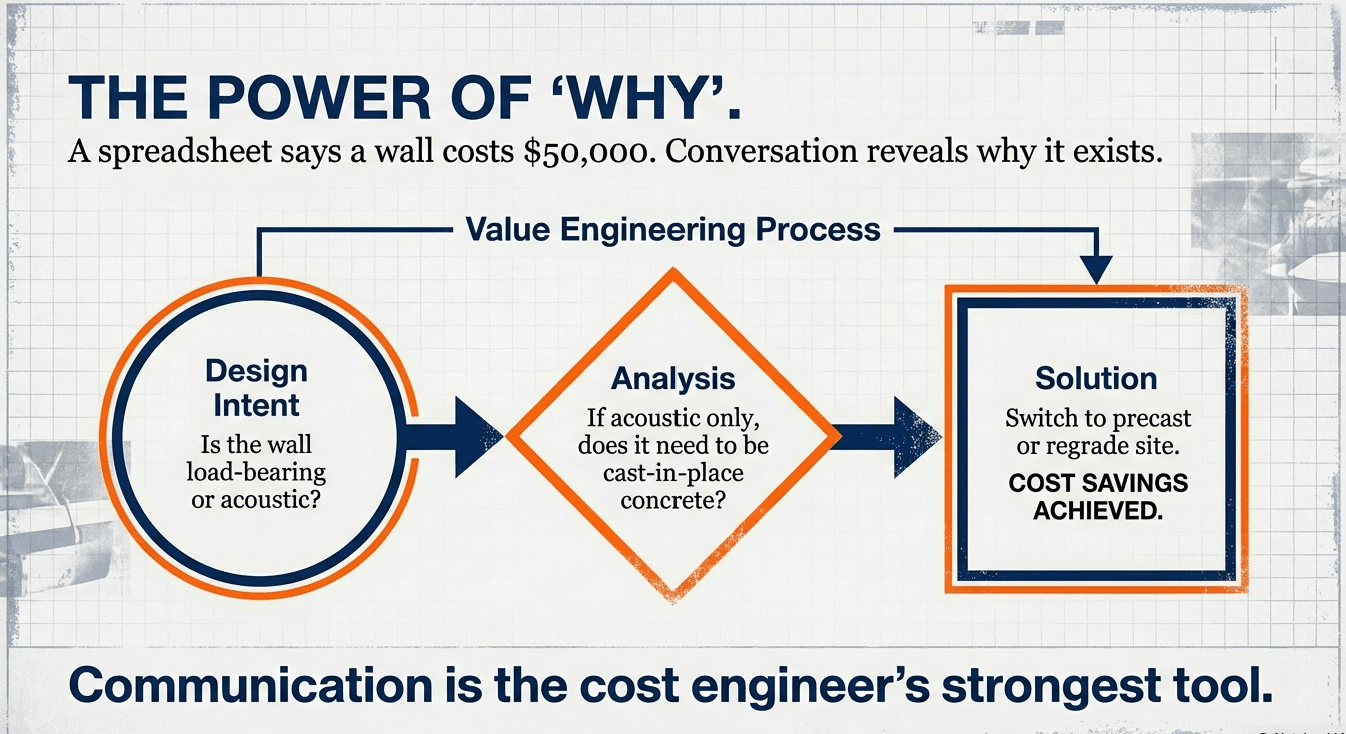
Expert Tip: Communication is the cost engineer’s strongest tool. Value Engineering is most effective when applied early in the design phase, where a single question about design intent can save more money than a hundred software-based calculations.
🧠 Expert Insights Q&A
For those navigating the complexities of large-scale infrastructure, here are the most common questions we receive regarding the nuances of civil engineering cost estimating:
Q1: Why might three estimators produce different results for a civil engineering cost estimating project using the same plans and specifications?
A: Because a seasoned estimator looks beyond the drawings at the “Invisible Scope”—site access, local labor premiums, and seasonal logistics.
Q2: Is “overestimating” a real problem in civil engineering?
A: In 20 years of experience, overestimation is largely a myth. The real challenge is combating the inevitable upward pressure on costs due to escalation and scope creep.
Q3: What is the most effective tool a cost engineer has?
A: Communication. Understanding the design intent is the only way to achieve true Value Engineering.
Q4: How does time directly affect project costs?
A: Through escalation. A project estimated in 2025 cannot be built in 2027 for the same price. Time effectively erodes purchasing power.
Q5: What is the difference between a “slush fund” and a professional contingency?
A: A slush fund is a guess. A professional contingency is a calculated buffer based on a Risk Register that assigns dollar values to specific uncertainties.
Conclusion: Building Resilience into the Budget
A cost estimate is more than just a price tag; it is a roadmap of the project’s future. By prioritizing a deep understanding of the Scope, treating Contingency as a calculated risk buffer, and strictly monitoring the Critical Path, we move beyond simple “pricing” and into true Project Controls.
At AI&GB Consulting, we believe that civil engineering cost estimating is about more than just numbers; it’s about building financial resilience into every project. Explore our full range of expert consulting services to see how we can secure your next infrastructure project.
Dr. Armelle Malcomb is the Founder of AI&GB Consulting LLC. With over 20 years of experience in civil engineering and project controls, she helps clients navigate the complexities of infrastructure development with data-driven precision.